


Every generation has its junk.
My parents lived through the Sexual Revolution of the 1970s.
I came of age during the height of the ‘90s Purity Culture.
My five kids are stepping into young adulthood and their teenage years during the Gender Revolution of the here and now.
Like I said, every generation has its junk.
And parenting through whatever junk life throws at your kids—while you’re still trying to heal from your own stuff—
Well, it’s messy.
Do it all under the watchful eye of the Evangelical Church, and sometimes it’s even messier.
Especially for a girl who grew up believing that children are an extension of their parents—and therefore a reflection of their parents’ character, competence, and even faithfulness.
I carried more of that belief than I realized.
Recently, I heard a phrase that stopped me in my tracks:
“Shame off me.”
Say what?
Shame off me.
As someone who spent years unconsciously living with a shame-on-me posture, those three words felt surprisingly hopeful.
Not because I’d never encountered the idea before.
But because someone had finally given language to something God has been quietly teaching me for years.
I haven’t always known how to live shame off me as a woman.
Or a wife.
Or a mother.
Truthfully, I didn’t know it was an option.
But along my journey of healing from legalism, I’ve begun to notice a subtle shift taking place. I’m learning to separate responsibility from shame. I’m learning that love doesn’t require control. And I’m learning that my children’s lives are not a report card on my worth.
Here are three ways I’ve slowly been practicing what I now think of as shame-off-me parenting.
1. My Kids Are Not My Reputation
Jeremy and I have five children, and they are all wildly different.
Introverts and extroverts.
Planners and seat-of-their-pants people.
Type As and Type Bs.
Strong-willed and easygoing.
And somewhere along the way, I noticed how easy it was to take other people’s opinions of my children personally.
Maybe it comes from twenty years in pastoral ministry. Maybe it comes from being an Enneagram One mom. Maybe it comes from growing up believing that “good parenting” produces predictable outcomes.
Whatever the reason, criticism aimed at one of my children often felt strangely personal.
If someone misunderstood them, I felt defensive.
If someone judged them, I felt exposed.
If someone questioned their choices, I quietly wondered what it said about me.
But healing has slowly taught me something important:
Not everyone is going to understand or appreciate my children.
And that’s okay. Their opinions are not mine to manage.
My responsibility is to love, guide, support, and influence my children. To be their biggest advocate, cheerleader, and (yes) their friend.
My responsibility is not to control how other people perceive them—or me.
Because my kids are not my reputation.
They are whole people, created in God’s image, with personalities, callings, strengths, weaknesses, and stories all their own.
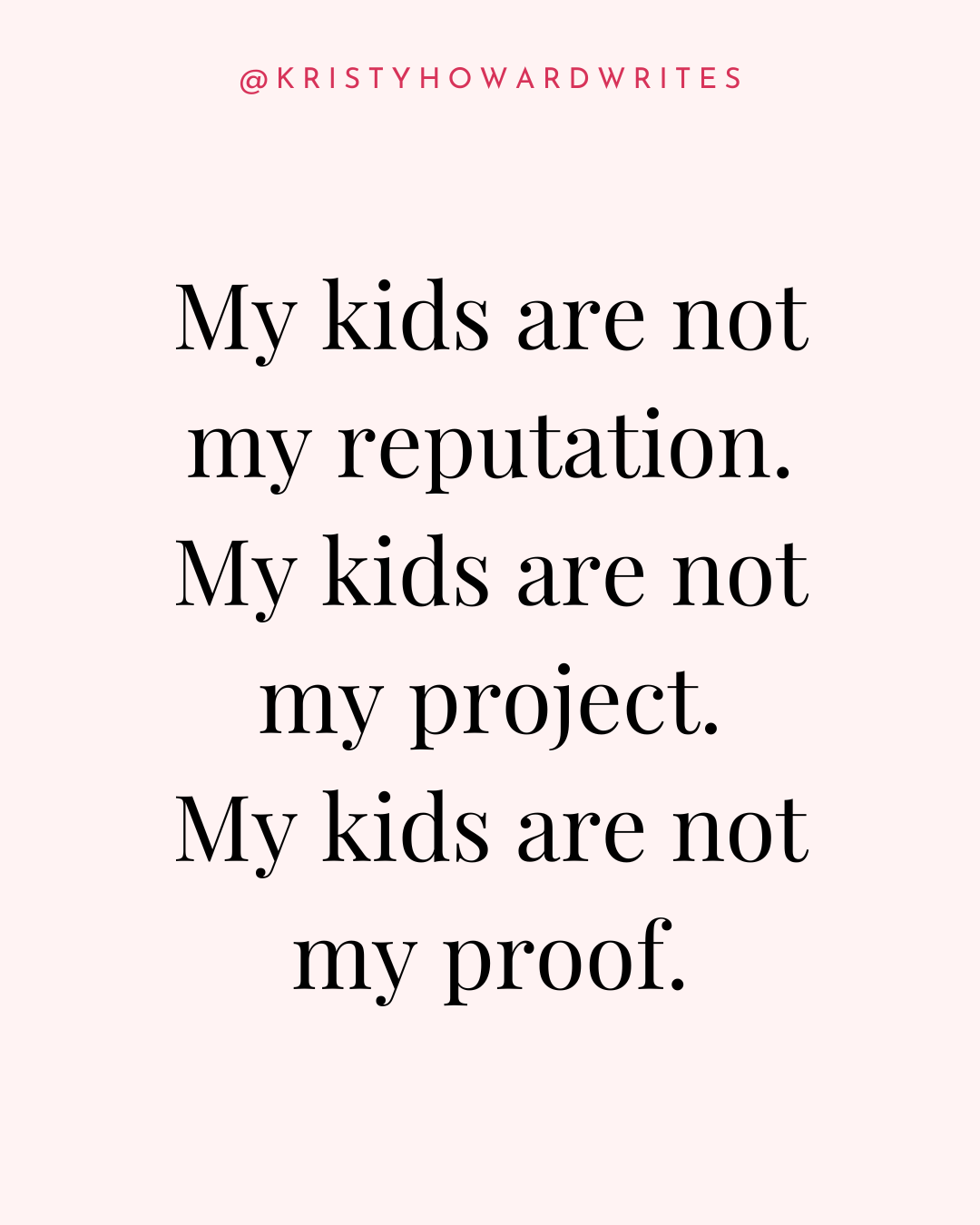
2. My Kids Are Not My Project
One of the hardest parts of parenting older children is realizing that influence and control are not the same thing.
When our children are little, we make thousands of decisions for them every year.
What they eat.
Where they go.
When they sleep.
What they learn.
But as they grow, our role begins to shift.
Slowly, then all at once. We move from managing their lives to mentoring them. From directing to guiding. From controlling outcomes to nurturing relationships.
And if you’re anything like me, that shift can feel terrifying. Because love naturally wants to protect.
But shame often wants to control.
I’ve had to learn that my job is not to manufacture perfect outcomes. My job is to remain present. To tell the truth. To offer wisdom. To apologize when I’m wrong. To keep the relationship strong enough to hold hard conversations.
And then, eventually, to trust God with the parts I cannot control.
That’s not passive parenting.
It’s deeply active. It’s just rooted in grace instead of fear.
3. My Kids Are Not My Proof
For years, I unknowingly carried the belief that successful parenting would somehow validate me. That if I did enough things right, my children would become evidence that I’d been a good mother.
But life doesn’t work that way.
Children are not trophies.
They are not cautionary tales.
They are not proof of our success or failure.
They are people.
People who will make wise choices and unwise choices.
People who will grow in some areas while struggling in others.
People who will surprise us, delight us, confuse us, and sometimes break our hearts.
Just like we do.
The older my children get, the more convinced I become that parenting is less about producing a finished product and more about faithfully loving another human being through every season of their becoming.
And that kind of love requires grace. Not just for our children. But for ourselves.
Because shame tells parents that every struggle is our fault—and every win is our trophy. Grace reminds us that we are responsible for faithfulness, not outcomes.
These days, “shame off me” doesn’t mean I care less about my children. If anything, it has helped me love them better.
It means I’m slowly laying down burdens God never asked me to carry. It means releasing the illusion that I can control another person’s story. It means trusting that God’s love for my children is deeper than mine.
And it means learning to love my children as whole people—not extensions of me.
For a woman raised on shame-shaped religion, that kind of parenting feels like hard-won, sacred ground.
And perhaps that’s what healing from shame looks like.
Not becoming a perfect parent.
Just a freer one.
Veritas et Gratia,
Kristy 💐